Tuesday, February 7, 2012

[B7] Unusual Art Mediums (Surgery Make-up)

After doing my mixed media project, I realized that there are an infinite amount of mediums one can use to create art.  This blog is dedicated to exploring the most unusual, awesome art mediums out there.

Beginning with trash.  This sculpture is called Lips by Tom Deininger.


The next unusual medium is recycled carrier bags.  This is called the Eden Project.


This medium is colored pencils.  The usage, however, is far from what you would expect.


This next sculpture by Liz Hickok is quite a bit more appetizing than the others.


Music becomes visual in this next sculpture, constructed using cassette tapes.


This piece called Chemical Balance is constructed using prescription bottles.


This music tends to flow over you. ;)


Artist Scott Wade uses one of the messiest mediums–dirt.


An infinite number of mediums makes for a wonderful world of art. :)  


Sunday, December 11, 2011

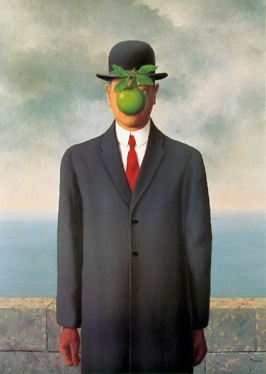
[B6] "The Son of Man" by René Magritte (Surgery Make-up: Week of Nov14)


     René Magritte was a Belgium surrealist artist known for his strange placement of non-deformed, everyday objects.  Rather than morphing the objects as many surrealist artists did, such as Dalí's melting clocks, Magritte preserved each object's characteristics, but arranged them in uncharacteristic ways.
    
     About the painting, Magritte said:
          At least it hides the face partly. Well, so you have the apparent face, the apple, hiding the visible but
     hidden, the face of the person. It's something that happens constantly. Everything we see hides another
     thing, we always want to see what is hidden by what we see. There is an interest in that which is hidden and
     which the visible does not show us. This interest can take the form of a quite intense feeling, a sort of
     conflict, one might say, between the visible that is hidden and the visible that is present.

     Magritte shows realism in the characteristics of individual objects.  By observing the bricks behind the man, one can determine that the piece is painted in one-point perspective.  The painting is nearly symmetrical, except for the overlap of the coat and the odd bend of the man's left arm.  The background is so simple, obviously meant to not draw attention from the man, that one may consider the piece somewhat minimalistic.  Magritte's use of shadows and highlights bring out the realism in the man's hands, coat, hat, and face.  The apple hangs, impossibly, in mid-air, hiding the man's face and lending a sense of mystery to the piece.  The apple also serves as the aspect which makes this piece surreal.  The background of the piece is almost completely painted using cool colors, and the middle ground is almost monochromatic with shades of gray.  The lines of the man's coat draws the viewer's attention up to the apple, which shades the face and serves as the focal point.  The vivid shade of green of the apple also illuminates it as the main aspect of the piece.

Monday, December 5, 2011

[B5] Bellarmine University (Surgery Make-up: Week of Nov7)


Bellarmine University is a liberal arts college in Louisville, Kentucky.  It offers 56 majors and 17 graduate programs.  Tuition per year is around $42k, but every applicant is offered financial aid.  One may apply to Bellarmine here.  By applying for the school, applicants are automatically considered for the highest scholarship for which they qualify, excluding the Bellarmine Scholars program.  In order to apply to be a Bellarmine Scholar, one must submit an essay answering the prompt, "Describe an incident in your life during which you intellectual curiosity was peaked."  If chosen as a Bellarmine Scholar, a student will receive a four year, all inclusive scholarship to the school.  The deadline for the Bellarmine Scholars essay is December 1st.  The early action deadline for application to the university is November 1st, but one may apply as last as June.

Students who possess a 21 ACT or a 990 SAT, have a 2.5 cumulative grade point average in a college prep curriculum, and are ranked in the top 50% of their class are generally admitted.  Required high school courses include 4 units of English, 3 units of math, 3 units of social sciences, 2 units of natural sciences with labs, and 2 units of foreign language.


The School of Art at Bellarmine University is instructed by professors who are also professional artists. Art majors may choose emphasis in painting, sculpture, or photography/digital art.  Courses offered include art history from ancient and medieval to Renaissance and modern art history, as well as independent studies, internships, and hands-on experience with drawing and composition, 3D design, ceramics, color imaging, photography, painting, figure drawing, and video art.  


Art resources within the city can be found here.

Wednesday, November 16, 2011

[B4] Goose Egg Art (Surgery Make-up: Week of Oct 31)

Utah artist Brian Baity makes his masterpieces from a quite unexpected material.  He uses ostrich eggs, rhea eggs, emu eggs, goose eggs, and gourds.  This specific piece is carved from a goose egg.


The process of creating this type of sculpture takes a lot of patience and an artist must be very careful.  A small hole is first made in the end of the egg and the yolk is sucked out.  Dental tools are used to gently carve away layers of shell.  Generally goose eggs are carved all the way through, but many eggs, such as ostrich eggs, which have differently colored layers, are only carved partially through to expose different values in the shell.


This egg in particular is very interesting because of the crisp lines and geometric shapes intertwining throughout.  Though perfect geometry generally indicates stability, this piece is quite the opposite.  The feeling of stability given off by the design contrasts with the fragility of the material itself.  Contrasting with the perfect, geometric design again is the round, smoothness of the piece as a whole.  


This piece really appeals to myself in particular because I enjoy artwork that utilizes unusual materials, mediums, or methods.  This piece employs all three.  Not only is it eccentric in those ways, but it also is completely natural and organic, a quality most art cannot claim.


Brian Baity's website may be found here.

Friday, November 11, 2011

[B3] What Do We Really Mean By Art? (Surgery Make-up: Week of Oct 24)

What Do We Really Mean By Art?
by at Smashing Magazine

This article addresses six questions regarding art today and the evolution of it throughout history, providing many visuals and featuring interviews with several different artists.

1. What Is Art?
The author begins the article by addressing this question. She states that "Art is generally understood as any activity or product done by people with a communicative or aesthetic purpose—something that expresses an idea, an emotion or, more generally, a world view." She continues to cite different definitions of art, even from Wikipedia, but summarizes by saying that, "In this article, we mean art as a form of human expression of a creative nature."

2. The Evolution Of The Concept Of Art
       The author begins by saying, "While the definition of art has changed over the years, the field of art history has developed to allow us to categorize changes in art over time and to better understand how art shapes and is shaped by the creative impulses of artists."  She interviews two very stylistically different artists, Alexander Daniloff and Jonathan Ball.  Daniloff is a Russian artist who lives in Italy and practices art using traditional styles and mediums.  Ball is the mastermind behind the designs of Poked Studio, a company that provides illustration, web design, blog design, graphic design, 3-D rendering and visualization, motion graphics, flash websites, and games. 
by Alexander Daniloff


by Jonathan Ball


3. Aesthetics In Digital Art
     The author then offers insight into the mid-20th century transition to digital media.  She confronts the view of many that "given the variety of tools at their disposal, how much effort do digital artists really have to put into their work?"  She interviews Jan Willem Wennekes, a freelancer, for his opinion on the subject.  The following pieces are examples of his work.


4. Art As We Know It Today
     The author defines the 20th century as a turning point in our conception of art.  She links this to the reason that contemporary artists often reach for new concepts which break with tradition and the classical notions of beauty.  She interviews Nate Williams, Travis Lampe, and Jonathan Ball regarding the subject.  Nate Williams is an artists, illustrator, and designer from the US who has worked extensively in the advertising world.  Travis Lampe is an illustrator who currently lives and works in Chicago, working in art and illustration.
by Dan May


5. News Media Revolution And Its Relationship To Artists
     The author now addresses the recognition of new forms of art as opposed to the already widely recognized forms such as painting, drawing, sculpture, music, literature, and performance.  She asks, "What exactly is the relationship between these new forms of expression and contemporary artists?"  She interviews Russian and German illustrators  Max Kostenko and Pino Lamanna to answer her questions.


by Leandro Lima


by Max Kostenko


6. Communication And Self-Promotion In The New Web
     Maraviglia concludes her article by addressing the relationship between artists and their audiences and the methods they use to self-promote.  She queries Bob FlynnAlex DukalJayme McGowanChris Piascik and Irma Gruenholz for their opinions regarding self-promotion.  

by Bob Flynn

Thursday, November 10, 2011

[B2] The Smoke (Surgery Make-up: Week of Oct 17)


"The Smoke" by ~lucaszoltowski on DeviantArt.

When I saw this piece, I was taken hold by the strong message it sends. This minimalistic photomanipulation uses many different elements to emphasize its depiction of the desperation and helplessness caused by addiction. In order to bring the viewer's eyes to it's focal point, the artist uses heavy contrast of the black ashes against the light background. The background also serves to stress the focal point by using a gradation of medium gray and white. The shadows beneath the cigarette create a very three-dimensional effect, which accentuates the realism of a faked photomanipulation. The contrast of the orange filter against the monochromatic remainder of the piece punctuates the cigarette as the main cause of the painful tone of the artwork.

Saturday, October 15, 2011

Hair, sweet hair.

"Hair, sweet hair" is an oil pastel piece of an artist known as Vive-le-Rock on DeviantArt. Here is the link, though it will be blocked on our beloved school Macs.
     I really adore this piece.  I initially actually found another piece called "A Thousand Faces" on DeviantArt here, but learned that it was based upon this piece, which I enjoy much more.
     As my preferred style is minimalism, this piece really appeals to me.  I love the bright, warm colored hair in contrast to the flat black background.  Even more amazing is how the cool, blue face contrasts the bright hair, with almost no discrepancy between warm and cool provided, except the sparse blue strands of hair throughout.  Even without a transition, it looks really amazing.
     Another aspect of this piece that intrigues me is how voluminous the artist makes the hair appear by her use of curved and curly, free lines.  The many colors she uses for the hair also lends to the piece a sense of wild fierceness.
     Another fantastic aspect of this piece is the use different values of blue to shadow the face, providing the transition from the bright, fluorescent colors in the hair to the cool, calm colors of the face.  I particularly enjoy the lips and the artist's use of white to highlight the face just perfectly to create the contours of the lips, cheeks, nose, and chin.  The barely visible left eye beneath the shadows also lends a sense of mystery and seduction to the piece. 
     There is also a sequel to the piece here, if you are interested. :)